
What changes on 30 November 2026?
From 30 November 2026, social landlords in England must apply Awaab's Law timescales to seven more hazard categories, including excess cold, electrical hazards and falls. The legal clock starts when the landlord becomes aware of a potential hazard, not when a job is raised. That makes first contact, triage and the record the parts of the repairs process most likely to fail.[1][2]
Phase 1 has applied to damp, mould and emergency hazards since 27 October 2025. Phase 2 keeps the same investigate, make safe and remedy structure and applies it across a much wider set of everyday repairs. A failed boiler, a loose handrail or water near a light fitting can all now sit on a statutory deadline, depending on severity and who lives in the home. Phase 3, expected in 2027, extends the law again.
What is the Housing Ombudsman finding?
Responsive repairs are where landlords fail residents most seriously. In 2025-26, repairs accounted for 355 of the Housing Ombudsman's 470 severe maladministration findings, or 75%, and 80% of the cases it decided included a finding about repairs. The Ombudsman named inadequate record keeping and knowledge management among the failures that run across these cases.[3]
The headline numbers are improving. Severe maladministration findings fell from 714 in 2024-25 to 470 in 2025-26, and the uphold rate dropped from 71% to 62%.[3][4] But the share of the most serious failures sitting in repairs has grown, and property condition findings rose 43% in 2024-25, well ahead of the overall rise in investigations.[4]
In March 2026, ahead of Phase 2, the Ombudsman's learning report on hazards challenged boards directly. Many landlords say they meet their legal obligations. The report asked what that confidence rests on and whether boards have tested their data against what residents actually experience.[5]
The question for boardsMany landlords say they are meeting their legal obligations on hazards. The Ombudsman asked:"What's this based on? How robust is the data?"
Where do Awaab's Law cases go wrong?
Most failures happen before an operative reaches the home. Across year one of Awaab's Law and the Ombudsman's severe maladministration reports, the same six points come up: the moment a report arrives, the moment it is classified, and the moments when information should travel with the job but doesn't.[5][6][7]
Day zero is missed
The clock starts at awareness. A report taken by phone, email or a housing officer at the door never becomes a timestamped record, so nobody knows the deadline is running.
The hazard isn't recognised
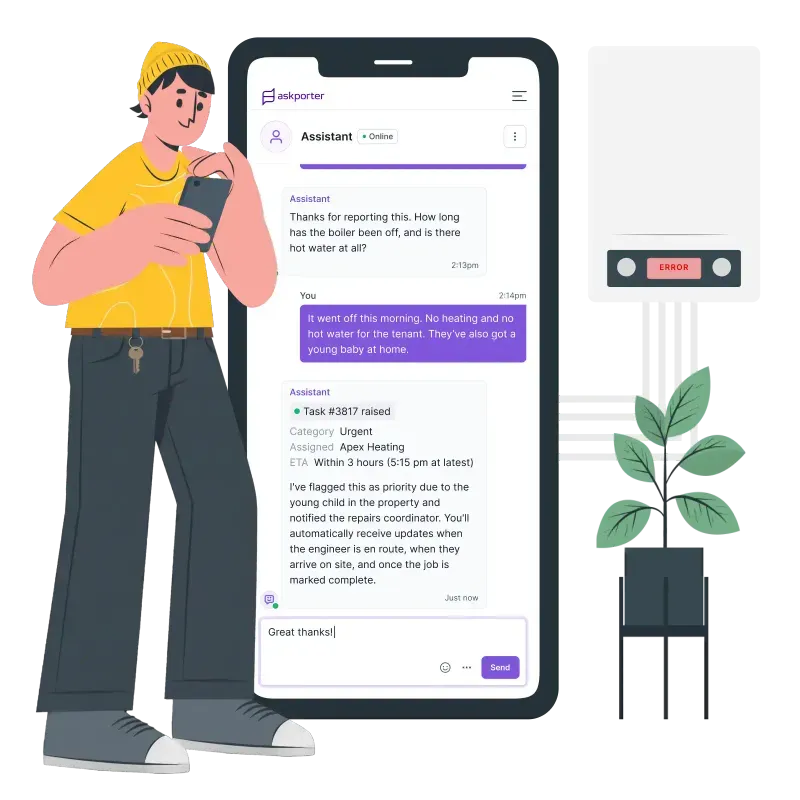
"No heating" logged as a routine boiler job. Water near electrics logged as a leak. Inconsistent classification happens depending on who took the call.
The household isn't linked to the repair
The landlord knows about the asthma, the newborn or the 81-year-old resident, but it sits in a tenancy record or vulnerability flag. The person raising the repair never sees it, so the job is prioritised as if nobody vulnerable lived there.
"No access" with no evidence
Cases closed as no access when the landlord can't show the resident was told anyone was coming, or offered another slot.
The job travels without its context
The wrong trade, the wrong flat, or a contractor who never saw the history. The source of the leak stays unfixed.
Repeat reports look new every time
Each report is answered on time and closed. The third, fifth or twentieth report on the same problem never shows up as a pattern.
What does a Phase 2 report look like at first contact?
Four illustrative reports, each a Phase 2 risk. Pick one to watch how askporter Housing handles the conversation, and what gets written to the record as it happens. Compare it with how the same report typically goes wrong.
Written to the record with askporter
How it typically goes wrong
Illustrative scenarios. Names, addresses and times are invented and do not describe real residents or landlords.
Which hazards does Awaab's Law Phase 2 cover?
Phase 2 adds seven categories from the Housing Health and Safety Rating System to the damp, mould and emergency hazards already covered. Whether a report falls under the law depends on the severity of the hazard and the household living with it, so the same repair can be routine in one home and a legal deadline in another.[1][2]
Damp and mould
Plus all emergency hazards.
Excess cold
No heating or a failed boiler, especially in winter or with older residents.
Excess heat
Overheating flats, failed ventilation, south-facing top floors.
Falls
Loose handrails, broken steps, unsafe balconies and windows.
Structural collapse
Bowing ceilings, falling render, loose roof elements.
Fire and explosions
Faulty smoke alarms, damaged fire doors, gas concerns.
Electrical hazards
Water near fittings, faulty consumer units, exposed wiring.
Domestic hygiene
Pests, sewage, food safety and personal hygiene facilities.
What are the Awaab's Law timescales?
| Hazard | Action | Deadline |
|---|---|---|
| Emergency | Investigate and make safe | 24 hours |
| Significant | Investigate | 10 working days |
| Significant | Written summary to the resident, after the investigation ends | 3 working days |
| Significant | Complete safety work | 5 working days |
| Significant | Start work to stop it recurring (or within 12 weeks where not practicable) | 5 working days |
Source: MHCLG, Awaab's Law Phase 2 guidance for social landlords.[1] The clock runs from when the landlord becomes aware of a potential hazard.
What comes after Phase 2 in 2027?
Phase 3, expected in 2027, is set to extend Awaab's Law to the remaining HHSRS hazards except overcrowding. No start date has been confirmed. By the end of 2027, nearly every significant hazard in a social home is likely to carry a legal deadline, so processes built only for damp and mould will not scale.[8]
Phase 1 in force
Damp and mould and all emergency hazards on statutory timescales.
Ombudsman's 2025-26 review
Repairs account for 75% of severe maladministration findings; record keeping named as a recurring failure.[3]
Competence and Conduct Standard
Senior housing managers must hold, or be working towards, a relevant housing qualification.[9]
Phase 2 in force
Seven more hazard categories, the same timescales and written summary rules, arriving as winter demand peaks.
Phase 3
Remaining HHSRS hazards except overcrowding. Date to be confirmed.[8]
Private rented sector
The Renters' Rights Act 2025 allows Awaab's Law to be extended to private landlords. No timetable yet.[8]
How ready is your point of report?
Tick each statement that is true for your organisation today. Be strict: if it depends on who is on shift, leave it unticked.
What should housing teams do before and after 30 November?

Test first contact
- Pull 20 recent repair reports and check whether each Phase 2 hazard would have been recognised when it was logged.
- Map your repair categories to the nine hazard categories and brief call handlers with real cases.
- Pick one source of truth for the four timestamps: report, investigation, written summary, works.
Watch the winter volume
- Track excess cold reports alongside damp and mould: both peak together.
- Rewrite contractor SLAs to the statutory clock and set escalation well before the deadline.
- Log every access attempt with the notice given, so "no access" can be evidenced.
Build for Phase 3
- Report to the board from the same case record used for statutory timescales.
- Flag repeat reports on the same property automatically.
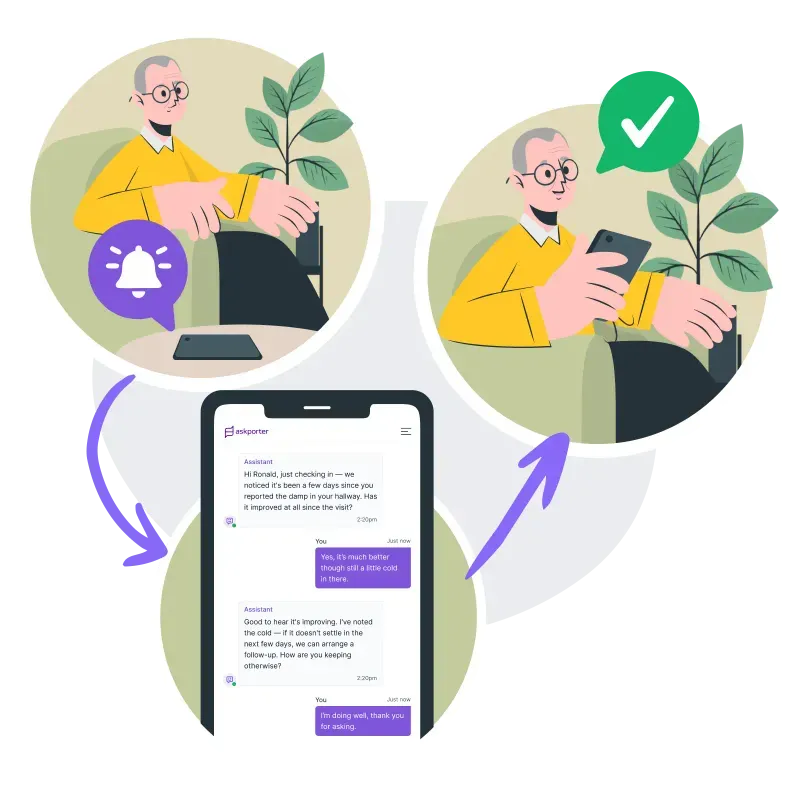
- Extend proactive outreach, such as winter welfare check-ins, to households you rarely hear from.
How does askporter Housing support Awaab's Law compliance?
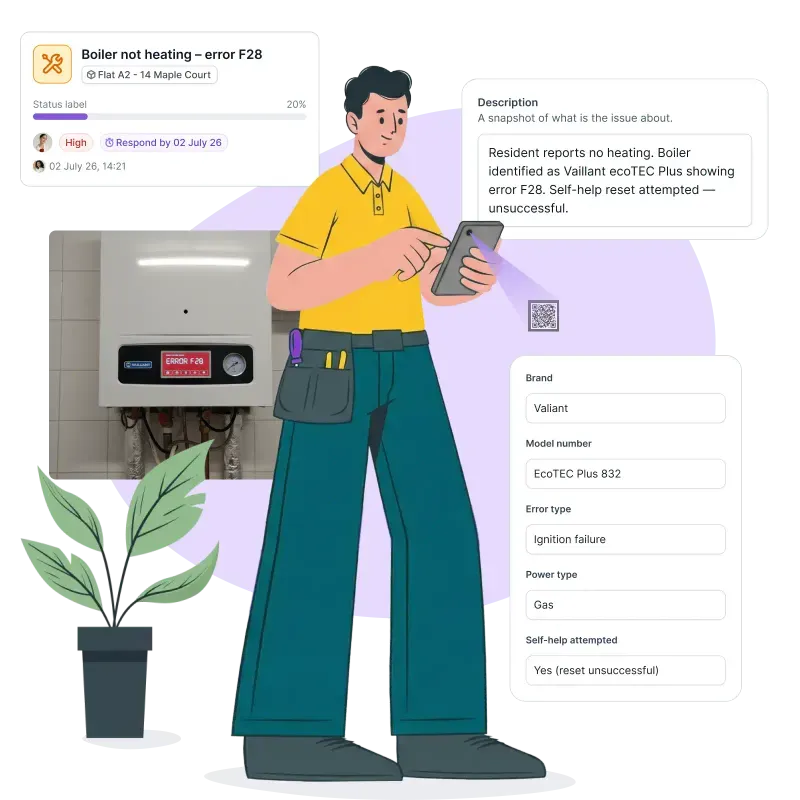
askporter Housing handles the point of report and the record. AI repair triage classifies each report when it arrives, across WhatsApp, SMS, email, web chat and voice, and every message, photo, appointment and update sits in one timestamped audit trail from first report to completed works. It works alongside your existing housing management system.
At Legal & General Affordable Homes, 97% of repairs are automatically diagnosed and allocated to the right supplier. Proactive Care adds the outbound side: welfare check-ins, compliance outreach and TSM surveys, with every response logged against the right resident.[10]
Awaab's Law Phase 2: frequently asked questions
When does Awaab's Law Phase 2 start?
Phase 2 comes into force on 30 November 2026 for social landlords in England. The Government confirmed the date on 13 July 2026.
Which hazards does Phase 2 cover?
Excess cold, excess heat, falls, structural collapse and falling elements, fire and explosions, electrical hazards, and domestic hygiene (including pests and food safety). These sit alongside damp and mould and emergency hazards, which have been covered since October 2025.
When does the Awaab's Law clock start?
When the landlord becomes aware of a potential hazard. That can be a resident report, a housing officer, a contractor or another third party. It is not when a job is raised in your system.
Is there a legal defence if we miss a deadline?
Social landlords have a defence if they took all reasonable steps to comply. In practice it depends on evidence: when you knew, what you investigated, what you told the resident and why any delay happened.
What is Awaab's Law Phase 3?
Phase 3 is expected in 2027 and is set to cover the remaining HHSRS hazards except overcrowding. No start date has been confirmed.
Does Awaab's Law apply to private landlords?
Not yet. The Renters' Rights Act 2025 contains the power to extend it to the private rented sector, but no timetable has been confirmed.
See how your repairs process maps to Phase 1, Phase 2 and Phase 3.
We'll walk through a real report from first contact to completed works, show where the clock starts, and point out the gaps an Ombudsman investigation would find.
- MHCLG, Awaab's Law Phase 2: Guidance for social landlords, updated 2026. gov.uk
- askporter, Awaab's Law Year One: what's changed, what hasn't and what's next, October 2026. askporter.com
- Housing Ombudsman, Annual Complaints Review 2025-26, 15 September 2026. housing-ombudsman.org.uk
- Housing Ombudsman, Annual Complaints Review 2024-25, 23 September 2025. housing-ombudsman.org.uk
- Housing Ombudsman, Learning from severe maladministration: hazards, March 2026. housing-ombudsman.org.uk
- Housing Ombudsman, Guidance on complaints involving hazards. housing-ombudsman.org.uk
- askporter, How to comply with Awaab's Law Phase 2: a step-by-step guide, July 2026. askporter.com
- MHCLG, Safer homes for 4m tenants with quicker action on dangerous homes, 13 July 2026. gov.uk
- Regulator of Social Housing, Competence and Conduct Standard, in force 1 October 2026. gov.uk
- askporter, Legal & General Affordable Homes case study; Proactive Care. askporter.com
This guide is general information, not legal advice. © 2026 askporter.